
| 20-07-26
Search
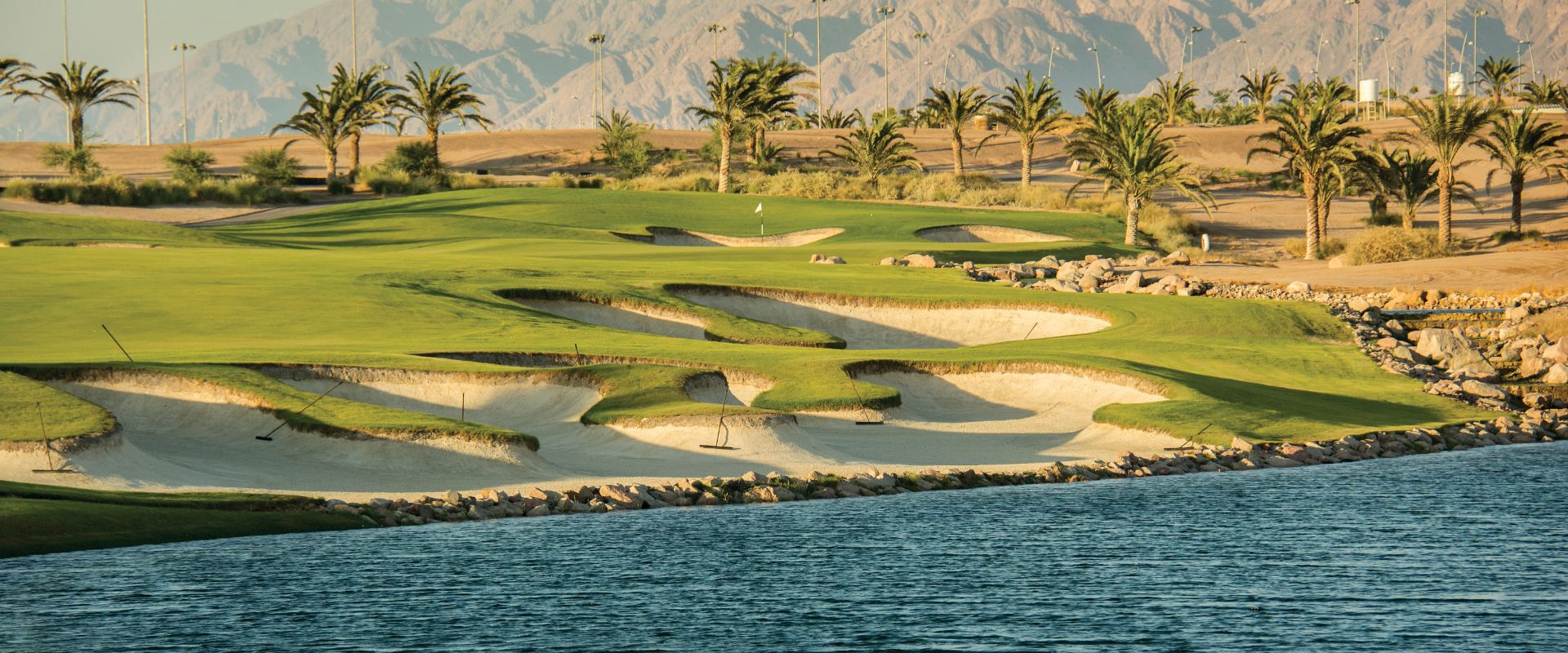
Sustainable golf in Jordan means managing turf in one of Earth’s most water-scarce places. Ayla Golf Club does it in Aqaba, between the Red Sea and the Hisma desert, maintaining an 18-hole championship course without drawing on the freshwater supply. Here is how the course is designed and run to hold that line.
Sustainable golf is framed by the GEO Foundation’s Development Standard as an international framework covering four pillars: nature protection and enhancement, resource efficiency, climate action, and community connections. That four-part frame matters in Jordan because water alone does not tell the full story. Aqaba, sitting between the Red Sea and the Hisma desert, faces extreme heat, flash-flood risk and high evaporation, conditions that make every resource decision matter. The GEO standard, applied here to Ayla Golf Club’s Greg Norman-designed 18-hole par-72 championship course and floodlit nine-hole academy course, pushes developers past irrigation hardware into habitat, energy, and community outcomes. It is also deliberately local: a course in Scotland and a course in Jordan face different baseline pressures, so the standard rewards responses shaped to place rather than a one-size-fits-all rulebook. For a destination like Ayla, 4.3 million sqm of waterfront in Aqaba, 10 minutes from King Hussein International Airport and about two hours from Petra, meeting that standard means decisions built into the design brief, not added later.
In a desert, the whole question is where the irrigation water comes from.
According to the Ayla Oasis 2023 Sustainability Report, golf-course and landscape irrigation at Ayla relies on tertiary-treated effluent specifically allocated by Aqaba Water Company, supplemented by a mix of brackish groundwater from wells and treated water. Neither source is presented as drinking water. Ayla says lagoon and golf-well water, including the man-made lake and wadi reservoirs, is tested regularly by third parties to keep it within standards and support aquatic life.
| Water Input | Sustainability Purpose |
| Tertiary-treated effluent (Aqaba Water Company) | Removes freshwater dependency for golf and landscape irrigation |
| Brackish groundwater mixed with treated water | Provides a second non-potable source; reduces draw on municipal supply |
| Closed-system water features and lagoons | Recycled within the site |
| Sustainable drainage and wadi reservoirs | Captures run-off; supports on-site water management |
The system design reflects Jordan’s National Water Strategy 2023–2040, which calls for significant expansion of treated wastewater for reuse in irrigation and targets reducing non-revenue water to 25% by 2040. Ayla’s approach aligns with that policy direction rather than working against it.
Reported loss-reduction measures include smart irrigation systems, water-efficient fixtures, wastewater recycling for landscape and golf-course irrigation, and regular third-party water-quality testing. Jordan News reported reclaimed irrigation water use at around 3,000 m³ per day across the golf club. Ayla’s 2024 Sustainability Report records the step that matters most for the course: a treated-wastewater irrigation system that it says removed the course’s dependency on freshwater.
Energy and water are rarely separate in a desert course’s operating budget, and at Ayla Golf Club the relationship is explicit.
Pumping, treating and distributing non-potable irrigation water uses electricity. Floodlighting the nine-hole academy course, the feature that enables night golf and junior programmes, adds to the load. Solar generation offsets a meaningful share of it: Jordan News reported in November 2025 that a 9-megawatt solar plant supplies a substantial share of the club’s energy needs.
“The work that Ayla have put into the project in terms of water conservancy and creating power through solar panels on the golf course is considerable, and goes hand in hand with what we are doing in our eco-friendly design.”
said Greg Norman, golf-course designer at Greg Norman Golf Course Design, on a 2014 Golfshake site visit.
The tradeoff is plain: treating and moving water in an arid environment uses a lot of energy. Solar generation does not remove that load, it lowers the carbon footprint of what remains.
Ayla Golf Club holds GEO Foundation certification for sustainable golf practices, recorded in Ayla’s 2024 Sustainability Report. The GEO standard covers resource efficiency, nature, climate action and community outcomes, not carbon metrics alone.
The academy-course lighting retrofit is where the sustainability case gets concrete.
Jordan News reported in November 2025 that LED lighting systems reduced electricity consumption by more than 57% across the club’s lighting systems.
Floodlit courses allow night play and junior programmes without extra land or turf. In Aqaba’s climate, where summer daytime temperatures regularly exceed 38°C, evening golf is not a novelty but the practical window for accessible sport. The nine-hole academy course at Ayla is fully floodlit, making it viable for the Ayla Hawks junior programme, schools outreach and the Golf & Green initiative without expanding the course footprint.
This kind of operational detail, named systems and measurable reductions, is what separates a sustainability-positioned course from one that installed solar panels and stopped there. The 2024 Sustainability Report puts a number on the course itself: introducing PV-powered irrigation and golf-course lighting reduced overall energy use by 25%. Across the wider destination, direct energy consumption fell 8% against 2023.
“All trees and shrubs have been carefully selected from local indigenous species to reduce the irrigation requirements, and a sub-surface irrigation system has been installed to reduce evaporation and water loss.”
said Sahl Dudin, CEO of Ayla Oasis Development Company.
That quote, from Golfshake’s 2014 site-visit report, captures the design-stage logic: indigenous species from Aqaba’s desert and coastal zones need less water than imported cultivars, so the planting list is itself an irrigation strategy.
The Ayla Feather Trail adds a second ecological dimension. Ayla’s 2023 sustainability reporting says it continued to promote the trail in partnership with the Royal Society for the Conservation of Nature (RSCN) as an educational initiative. Ayla’s materials also describe the trail as part of a major migration corridor used by species including the Eurasian Hoopoe and Greater Flamingo from September to May.
At the destination scale, Ayla’s wider reporting adds lagoon and marina biodiversity, including nearly 103 surveyed fish species, about half of the Gulf of Aqaba’s shallow-water species. Those results belong to Ayla as a whole. The golf-specific record is the indigenous planting, the habitat-sensitive design, and the Feather Trail itself.
The sea off that coast has its own standing now. On 25 July 2026 the Aqaba Marine Reserve became Jordan’s first natural UNESCO World Heritage inscription, covered in Ayla’s guide to snorkelling and diving in the reserve.
Sustainability at Ayla Golf Club is not confined to the turf.
The 13,000 ft² clubhouse, designed by Oppenheim Architecture, responds to Aqaba’s coastal climate through passive design: openings are sized to capture coastal breezes, and perforated corten steel screens filter sunlight without blocking views of the mountain range behind the course. The concrete shell uses soil from the site and local minerals, and the construction transferred skills directly to Aqaba craftspeople, an intentional economic outcome alongside the environmental one.
On the course itself, fairway bunkers were cleaned and reshaped in 2024 using locally sourced, sustainable sand. Sourcing sand locally cuts transport-related emissions compared with importing specialist bunker materials from outside the region. A circular groundskeeping practice completes the picture: verti-cutting operations produce organic debris rich in nutrients, which the grounds team redistributes across specific course areas as natural fertiliser rather than removing it as waste. This closes a small but measurable nutrient loop and reduces reliance on synthetic inputs.
Passive cooling, site-derived materials, local supply chains, circular maintenance: sustainability at Ayla runs through every layer of the built environment, not only the irrigation hardware that earns the headlines.
The GEO Foundation’s standard is explicit that community connections are a defining pillar of sustainable golf, not a bonus. For a course in Aqaba, that means asking what skills, access and participation the development leaves behind.
The concrete evidence comes from Ayla’s own reporting. The 2023 Sustainability Report records 120 junior golfers funded through the Jordan Golf Federation that year. The 2024 report adds a Schools Golf Programme launched in April 2024 across four local schools, reaching more than 80 students with 30% female participation, alongside more than 60 junior training sessions run with local schools.
These are not large numbers by global standards. But they are verifiable, named and specific, which matters in a region where golf has historically struggled to connect to local communities rather than simply host international tournaments.
The Ayla Hawks junior programme reinforces this picture with structured coaching, progressive skill development and on-course experience for young players across different age groups. Combined with the Makarem Academy and broader community investment, the golf club sits inside a destination that treats community outcomes as measurable rather than aspirational.
“Ayla Golf Club brings our vision to life, transforming sport into a sustainable experience where design innovation and natural beauty exist in perfect balance.”
said Sahl Dudin, CEO of Ayla Oasis Development Company.
Sustainable golf should leave something behind beyond a well-kept fairway. At Ayla, the record is specific and named, and it points to a club doing exactly that.
Explore golf at Ayla Golf Club and plan your round.
In Jordan, a sustainable golf course has to do more than look green. The GEO Foundation’s standard defines sustainable golf around nature protection, resource efficiency, climate action and community connection. Jordan’s water strategy makes responsible irrigation sourcing especially important: renewable freshwater stood at just 61 m³ per person per year in 2021, per the Ministry of Water and Irrigation.
Ayla reports that golf-course and landscape irrigation uses tertiary-treated effluent from Aqaba Water Company and a mix of brackish groundwater from wells and treated water, not municipal drinking water for direct consumption. The most accurate description is a non-potable irrigation mix, supported by regular third-party water-quality testing, per the 2023 Sustainability Report.
Largely through what is planted and how it is watered: indigenous species that need less water, smart irrigation controls, water-efficient fixtures and recycled wastewater, with lagoon and golf-well water tested by third parties. Golfshake also attributed a sub-surface irrigation system to the course in its 2014 report.
No published source supports a claim of full solar supply. Jordan News reported in November 2025 that a 9-megawatt solar plant supplies a substantial share of the club’s energy needs. The golf-specific installation supports irrigation and lighting; renewable generation lowers the footprint of those systems rather than eliminating grid dependency entirely.
Some are and some are not. The 25% cut in energy use from PV-powered irrigation and course lighting, reported in the 2024 Sustainability Report, is specific to the golf course. The 8% fall in direct energy consumption in 2024 covers Ayla’s wider operations. Golf-specific reporting is also strong on irrigation sources, the LED lighting retrofit and course-management practices such as verti-cutting debris reuse.
Golf-specific measures include indigenous planting, habitat-sensitive design and the Ayla Feather Trail linked to RSCN partnership activity. Wider destination biodiversity results, including lagoon fish surveys and coral restoration, should not be attributed to the golf course alone.

